
Mastering GMO: A Technical Guide to Google Maps Optimization for Multi-Location SEO Platforms

Google Maps is more than just a navigation tool. It's a local search engine. Whether someone’s looking for a dentist near them, a nearby pet store, or directions to a coffee shop, Google Maps is often their first stop.
That’s where GMO, or Google Maps Optimization, becomes a mission-critical strategy. It’s not just about being present on the map. It’s about ranking well in Google’s local pack, showing accurate data, and ensuring each business location is findable, trustworthy, and competitive.
In this post, we’ll break down what GMO is, why it matters, how to approach it programmatically, and how to help your clients choose the right optimization levers for their verticals.
What Is GMO (Google Maps Optimization)?
GMO refers to the set of actions and tactics used to improve the visibility of a business location within Google Maps results. Unlike traditional SEO, which targets search engine results pages, GMO focuses specifically on the map interface, Google Business Profiles, and local pack rankings.
Key components of GMO include:
- Optimizing Google Business Profile (GBP) data
- Managing categories, hours, photos, and business descriptions
- Earning and responding to local reviews
- Embedding location-based keywords in listings
- Using local citations and backlinks
- Ensuring consistent NAP (Name, Address, Phone Number) across all directories
For SaaS platforms, this is an opportunity to automate and scale these efforts across thousands of locations through data standardization and API-driven updates.
Why GMO Matters for Multi-Location SEO Providers
Let’s be clear. If your clients are not ranking well in Google Maps, they’re missing a huge source of discovery.
Here’s why GMO is critical:
- The map is the homepage for many local businesses
- Over 80% of local mobile searches result in a visit or contact within 24 hours
- Google’s local pack results are increasingly location-sensitive and real-time
- A strong Maps presence supports branded search, voice assistants, and driving directions
More importantly, Google is prioritizing intent-based local results. That means relevance, distance, and prominence are calculated using multiple signals, many of which you can optimize directly or indirectly.
Programmatic GMO: How to Scale It with APIs
GMO needs to be treated like a technical workflow. Manually managing Google Business Profiles for hundreds or thousands of locations is a dead-end. For SaaS SEO providers, GMO needs to be treated like a technical workflow.
Here’s how to approach it:
- Centralize Your GBP Data
Use tools like the Listings API from Local Data Exchange to push consistent, structured data into GBP. This includes:
Categories
Hours of operation
Photos and logos
Service areas
Business attributes (Wi-Fi, wheelchair accessibility, etc.)
Local links (menus, appointments, orders) - Categories
- Hours of operation
- Photos and logos
- Service areas
- Business attributes (Wi-Fi, wheelchair accessibility, etc.)
- Local links (menus, appointments, orders)
- Sync with Other Directories
Google cross-checks data from other authoritative sources. Syndicating your listings to platforms like Yelp, Bing, and Apple Maps reinforces your data’s trustworthiness. - Automate Review Monitoring and Responses
Use a Reviews API to programmatically track, store, and respond to reviews. Engagement drives prominence. - Geo-Targeted Content
Help each location build localized landing pages and post geo-targeted updates via the Google Business Profile posts feature. - Embed Google Maps Data in On-Page SEO
Add schema markup and embed dynamic Maps on local pages to reinforce location signals.
Choosing the Right Focus Areas by Business Type
Not every location needs the same level of GMO depth. Use the table below to prioritize:
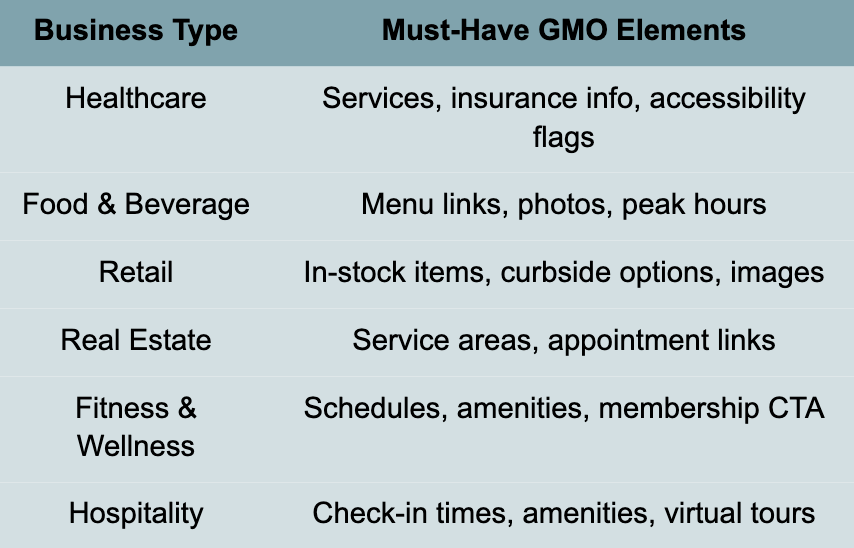
If you're serving multiple industries, build logic into your system that automatically adjusts data fields and metadata based on business vertical.
Don’t Ignore the Map Pack
Appearing in the top 3 of the local map pack drives the majority of clicks and visits. While Google uses a blend of proximity, relevance, and prominence, you can influence:
- Relevance by matching business categories and keyword usage
- Prominence by earning reviews, backlinks, and citations
- Proximity by optimizing service areas and accurately placing pins
The map pack is real estate your clients can’t afford to miss. GMO is how you help them earn it.
Google Maps Optimization is no longer optional. It’s a foundational layer of local search strategy. For SaaS platforms supporting multi-location businesses, GMO needs to be automated, standardized, and monitored at scale.
By embedding this into your SEO offering, you're helping brands meet customers where they’re searching, boost trust, and stay competitive in the local algorithm landscape.
Need to optimize thousands of Google Business Profiles at once?
Let’s talk GMO strategy and show you how to do it at scale using our Listings API.
Contact Us
Related Posts

How Reviews Shape Trust in Zero-Click Local Search Results
Local search no longer ends with a click. In fact, many of the most valuable local search interactions happen without one. Users increasingly make decisions directly from search results pages, Google Maps previews, and AI-generated summaries. These are known as zero-click local search results. In this environment, reviews have become one of the most powerful […]
Read More
How AI-Powered Search Is Redefining Local SEO Data Requirements
Local SEO used to tolerate imperfect data. Minor inconsistencies in business names, outdated hours, or conflicting categories could still produce acceptable rankings. That tolerance is disappearing fast. AI-powered search has fundamentally changed how local data is evaluated. Instead of relying on isolated signals, modern search systems synthesize data across many sources, compare it against real […]
Read More
Architecting for Sovereignty: Leveraging Local Data Exchange to Minimize Egress Costs and Latency in Hybrid Clouds
The rapid expansion of hybrid cloud environments has introduced a significant economic challenge: data gravity. While the public cloud offers unparalleled elasticity for compute, the financial burden of moving large datasets out of these environments often creates a “cloud jail” effect. For US enterprises, maintaining data sovereignty while controlling costs requires a tactical shift toward […]
Read More
Why Star Ratings Alone No Longer Tell the Full Story
For years, star ratings were treated as the primary indicator of reputation in local search. A higher rating meant more trust, better visibility, and stronger conversion performance. While star ratings still matter, they no longer tell the full story for search engines or customers. Local search has become more sophisticated, more competitive, and more context-driven. […]
Read More
How Brands Use Review Data to Improve Local Conversion Rates
Local SEO visibility is only half the battle. The real outcome brands care about is conversion. Calls, direction requests, bookings, and in-store visits are what turn rankings into revenue. Yet many brands focus on review volume and ratings without fully leveraging the data reviews provide to improve conversion performance. Review data is one of the […]
Read More