
Choosing the Right Geo Grid Tool: A Smarter Way to Track Local Rankings
Why Local Rank Tracking Needs Precision
Local SEO is about visibility near your customers. But search results aren’t static. A business can rank #1 for “coffee shop” in one suburb and vanish from the map two blocks away.
That’s where geo grid ranking tools come in. They reveal how search visibility changes based on physical location, helping marketers and brands see the true local search landscape.
What Is a Geo Grid Ranking Tool?
A geo grid ranking tool measures how your business ranks across a defined area, block by block or suburb by suburb.
It does this by simulating searches from multiple coordinates across a map grid. Each point on that grid represents a different search location, allowing you to visualize where your business appears in Google’s Local Pack or Map results.
The output is usually a heatmap or ranking grid, where each cell shows your position for a keyword at that spot. Green means high visibility; red means your business isn’t showing up.
This kind of visual analysis helps local marketers:
- Identify areas of strong or weak visibility.
- Detect ranking patterns around competitors.
- Plan hyper-local SEO campaigns with real-world data.
Key Features to Look for in a Geo Grid Tool
Not all geo grid tools are built the same. When evaluating them, focus on flexibility, data quality, and scalability.
1. Customizable Grid Size
Many platforms lock users into fixed grid sizes (like 9×9 or 13×13). This might work for large campaigns, but it’s inefficient for small businesses or specific target areas.
Our GEO Grid API lets you choose your grid layout, whether that’s 5×5, 7×7, or any custom configuration. This flexibility makes it perfect for:
- Local shops that only need a small coverage radius.
- Multi-location brands that want consistent data without overpaying for redundant points.
- Enterprise chains that need broader grids for national coverage.
2. Real-World Search Accuracy
The best tools simulate real user conditions, not generic proxy searches. They use precise GPS coordinates and neutral environments to reflect actual map results, ensuring data integrity.
3. Multi-Location and Keyword Support
If you manage multiple storefronts or service areas, your geo grid should handle bulk queries efficiently, ideally via an API. That allows automation, batch tracking, and consistent comparisons across locations.
4. Data Export and API Integration
Being able to plug ranking data directly into dashboards or analytics workflows saves time. Our API-based approach means your team can integrate geo grid results into existing systems easily.
5. Historical Tracking
Spotting trends is as important as capturing snapshots. Look for tools that let you compare today’s visibility with last month’s or last quarter’s.
6. Competitor and Radius Control
The ability to define which competitors to benchmark against, or how wide your search radius extends, is key for actionable insights.
Metrics a Great Geo Grid Should Track
Beyond pretty maps, a true geo grid tracking system should deliver quantifiable performance metrics that inform strategy.
- Average Local Rank: Your mean position across all grid points for a keyword.
- Top 3 / Top 10 Share: The percentage of locations where you appear in top results.
- Visibility Coverage: How much of the grid you dominate compared to competitors.
- Change Over Time: Historical shifts in rank and coverage.
- Competitor Proximity: Where rival listings outperform you geographically.
- Keyword Strength by Area: Pinpoint neighborhoods where certain terms perform better.
These insights help you align SEO efforts with on-the-ground visibility, optimizing resources for real-world impact.
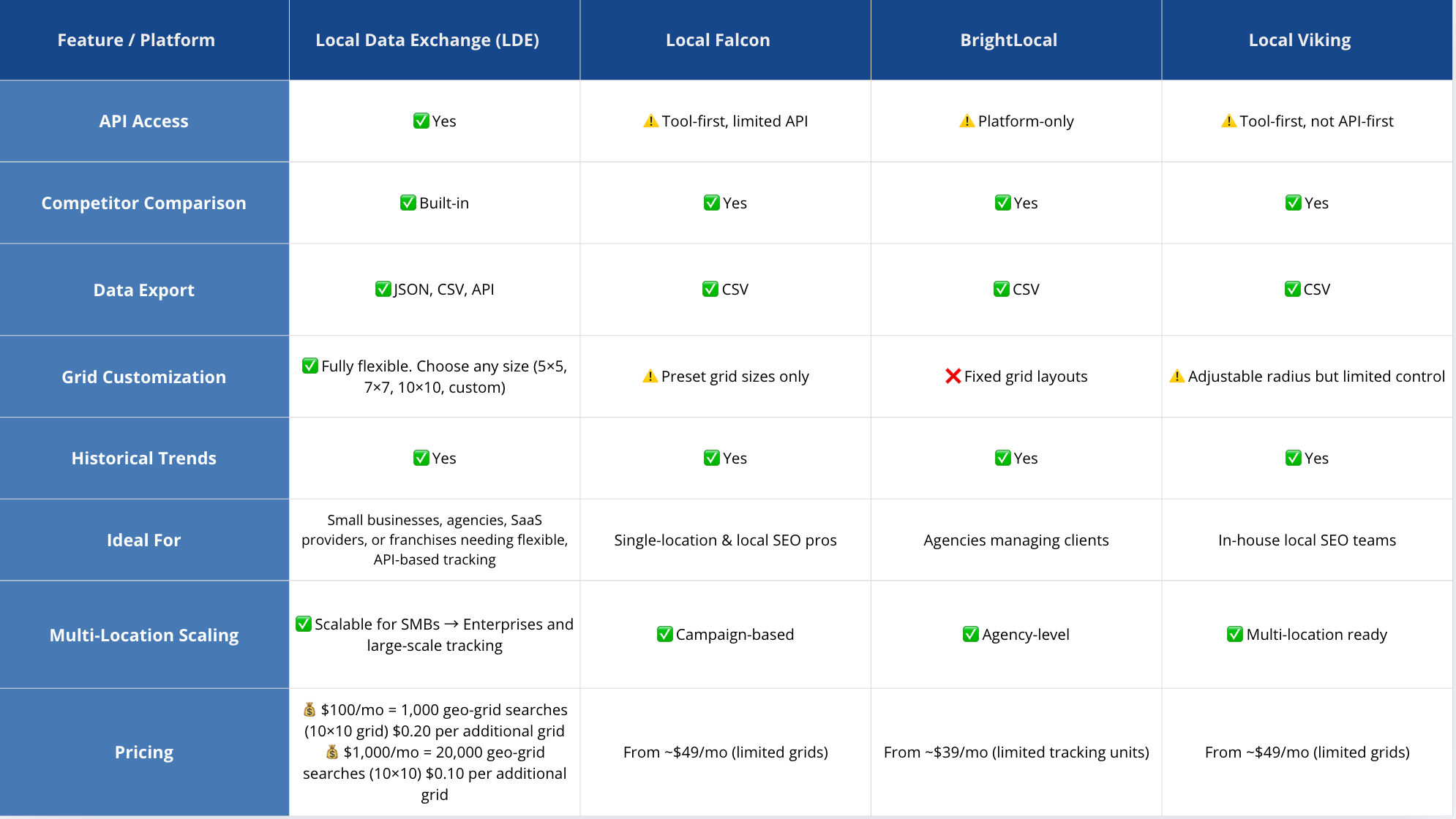
Comparing Leading GEO Grid Tools
Why Custom Grid Size Matters
This is where your GEO Grid API truly stands apart.
Fixed grid tools often force users to overpay or over-collect data they don’t need. A small business might only need visibility within a 3 km radius, not across an entire city grid.
With customizable grids, you can:
- Run 5×5 grids for local shops or single-service areas.
- Scale to 7×7 or larger for multi-location or national coverage.
- Tailor your data scope (not too narrow, not too broad) ensuring efficient API use and cleaner insights.
This balance of control and scalability is what makes your GEO Grid API ideal for agencies, franchises, and SMBs alike.
Flexibility Is the Future of Local Tracking
The future of local SEO depends on how precisely you can see your visibility.
A good geo grid tool collects rankings and tells you where you’re winning and where you’re invisible.
By combining custom grid control, accurate location simulation, and scalable API access, your GEO Grid API delivers the kind of local intelligence both small businesses and enterprise brands need to grow efficiently, accurately, and at scale.
Sources: Brightlocal, LocalFalcon and Local Viking.
This blog post resolves the following questions:
- What is a Geo Grid Ranking API?
- What's the market pricing for the Geo Grid APIs?
- What's the best Geo Grid API provider?
Related Posts

How Reviews Shape Trust in Zero-Click Local Search Results
Local search no longer ends with a click. In fact, many of the most valuable local search interactions happen without one. Users increasingly make decisions directly from search results pages, Google Maps previews, and AI-generated summaries. These are known as zero-click local search results. In this environment, reviews have become one of the most powerful […]
Read More
How AI-Powered Search Is Redefining Local SEO Data Requirements
Local SEO used to tolerate imperfect data. Minor inconsistencies in business names, outdated hours, or conflicting categories could still produce acceptable rankings. That tolerance is disappearing fast. AI-powered search has fundamentally changed how local data is evaluated. Instead of relying on isolated signals, modern search systems synthesize data across many sources, compare it against real […]
Read More
Architecting for Sovereignty: Leveraging Local Data Exchange to Minimize Egress Costs and Latency in Hybrid Clouds
The rapid expansion of hybrid cloud environments has introduced a significant economic challenge: data gravity. While the public cloud offers unparalleled elasticity for compute, the financial burden of moving large datasets out of these environments often creates a “cloud jail” effect. For US enterprises, maintaining data sovereignty while controlling costs requires a tactical shift toward […]
Read More
Why Star Ratings Alone No Longer Tell the Full Story
For years, star ratings were treated as the primary indicator of reputation in local search. A higher rating meant more trust, better visibility, and stronger conversion performance. While star ratings still matter, they no longer tell the full story for search engines or customers. Local search has become more sophisticated, more competitive, and more context-driven. […]
Read More
How Brands Use Review Data to Improve Local Conversion Rates
Local SEO visibility is only half the battle. The real outcome brands care about is conversion. Calls, direction requests, bookings, and in-store visits are what turn rankings into revenue. Yet many brands focus on review volume and ratings without fully leveraging the data reviews provide to improve conversion performance. Review data is one of the […]
Read More