
Review Spam Detection with AI: What Works and What’s Overhyped
As online reviews continue to shape consumer behavior and local SEO performance, review spam has become one of the biggest threats to trust and rankings. Fake positive reviews inflate competitors. Malicious 1-stars damage reputations. Bot-generated content clutters platforms with noise. At scale, this becomes a serious liability for SaaS providers managing the presence of multi-location brands.
AI-powered review spam detection it’s one of the most buzzed-about features in review tech, but how well does it actually work? Can you trust AI to flag fake reviews at scale? Or is it just another overhyped promise?
This article breaks down what AI-powered review spam detection can realistically deliver, where it still falls short, and how SaaS SEO platforms can implement systems that strike the right balance between automation and accuracy.
What AI Actually Does Well in Spam Detection
Pattern Recognition Across Large Datasets
AI thrives on volume. When fed thousands (or millions) of reviews, machine learning models can detect abnormal patterns that humans would never spot:
- Reused phrases or sentence structure
- Repeated keywords across different locations
- Clustered review activity within small time windows
- Reviewer accounts with suspicious activity (e.g., only 1-star reviews or reviews across distant regions in minutes)
AI models trained on labeled datasets can reach 85–95% precision when flagging spam-like behavior based on historical patterns especially if they have access to metadata like IP ranges, timestamps, and location mapping.
Language Sentiment and Semantic Analysis
Natural Language Processing (NLP) enables AI to analyze tone, emotional content, and language structure. It can:
- Spot overly generic language (“Amazing service!” repeated across reviews)
- Detect sentiment inconsistency (e.g., 5 stars but the language is negative)
- Identify off-topic or incoherent content (hallmarks of bots)
Some models can even tag urgency or escalation potential based on word usage. For multi-location brands, this makes AI invaluable in triaging large volumes of reviews into categories: legitimate, suspicious, urgent.
Automation of Escalation Workflows
AI doesn't just detect spam, it can route it. And smart platforms use AI to auto-flag reviews that match a spam confidence threshold, escalate high-impact reviews (e.g., 1-stars on high-volume locations) and trigger internal alerts or customer service workflows.
This enables SaaS SEO providers to handle spam proactively and reactively.
What’s Overhyped (Or Still in Beta Territory)
One-Model-Fits-All Detection
Many vendors promote pre-trained spam detection models as plug-and-play. In reality, these models:
- Are often trained on outdated or generic data
- Miss vertical-specific review language (e.g., “drill hurts” is normal in dentistry, but flagged as negative)
- Lack location context (they don’t know if two locations are part of the same brand)
Best practice: Fine-tune models using your clients’ historical review data, segmented by industry and location type.
Reliable Detection of Sophisticated Fake Reviews
Advanced fake reviews are crafted by humans and often with insider knowledge or subtle language cues that mimic real reviews.
AI struggles when:
- Reviews are grammatically correct but subtly misleading
- Sentiment is neutral or mixed
- Reviewer accounts appear “aged” and diverse
The most dangerous spam is often the hardest for AI to catch.
Publisher-Agnostic Detection
Google, Yelp, TripAdvisor, and Facebook all format and structure reviews differently. AI models trained on one platform’s data won’t necessarily perform well across others.
Multi-location platforms need cross-platform normalization before applying AI models.
How SaaS Platforms Should Implement AI for Review Spam Detection
Use AI to Assist, Not Replace Human Review. Think of AI as a filter and not a final judge that should:
- Sort reviews by spam probability score
- Flag outliers and repetition
- Provide sentiment and keyword tags
But always leave space for human confirmation especially before removing or reporting a review.
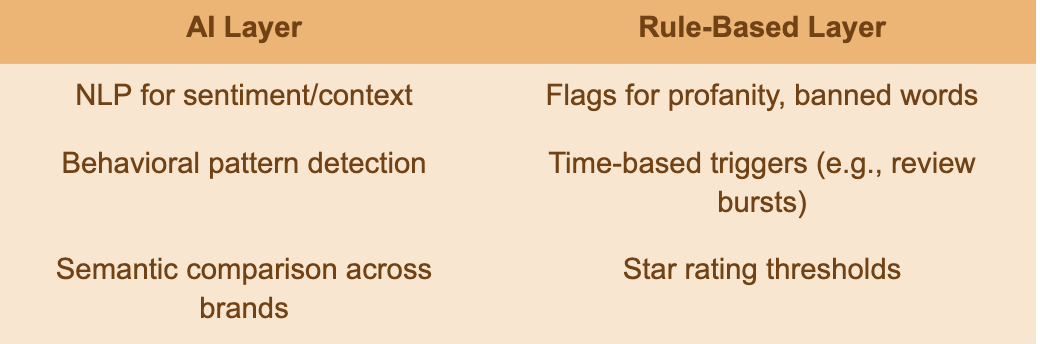
Combine AI with Rule-Based Logic
Hybrid models are the gold standard:
This dual approach improves accuracy and reduces false positives.
Integrate Escalation with Review APIs
Once reviews are tagged, tie them into your platform’s API-driven workflow:
- Feed suspicious reviews into a support ticket system
- Tag and archive flagged reviews for re-submission
- Update client dashboards with spam impact metrics
Bonus: Use Listings APIs to verify location ownership and ensure spam is hitting the right listing.
The Strategic Value of Spam Detection at Scale
For SaaS SEO providers, AI-powered spam detection offers a triple win:
- Protect client reputation in real-time
- Avoid SEO penalties from spam-diluted review signals
- Build trust through transparent reporting and proactive cleanup
Even better, these tools create value clients can see, helping you justify platform fees and retention with tangible outcomes.
Some common questions this article solves:
“What AI techniques are most effective for detecting fake reviews, and which ones are more hype than help?”
“How can SaaS platforms use machine learning to identify and flag review spam across multiple sources?”
“What are the limitations of current AI tools for review spam detection, and how can businesses supplement them?”
Related Posts

How Reviews Shape Trust in Zero-Click Local Search Results
Local search no longer ends with a click. In fact, many of the most valuable local search interactions happen without one. Users increasingly make decisions directly from search results pages, Google Maps previews, and AI-generated summaries. These are known as zero-click local search results. In this environment, reviews have become one of the most powerful […]
Read More
How AI-Powered Search Is Redefining Local SEO Data Requirements
Local SEO used to tolerate imperfect data. Minor inconsistencies in business names, outdated hours, or conflicting categories could still produce acceptable rankings. That tolerance is disappearing fast. AI-powered search has fundamentally changed how local data is evaluated. Instead of relying on isolated signals, modern search systems synthesize data across many sources, compare it against real […]
Read More
Architecting for Sovereignty: Leveraging Local Data Exchange to Minimize Egress Costs and Latency in Hybrid Clouds
The rapid expansion of hybrid cloud environments has introduced a significant economic challenge: data gravity. While the public cloud offers unparalleled elasticity for compute, the financial burden of moving large datasets out of these environments often creates a “cloud jail” effect. For US enterprises, maintaining data sovereignty while controlling costs requires a tactical shift toward […]
Read More
Why Star Ratings Alone No Longer Tell the Full Story
For years, star ratings were treated as the primary indicator of reputation in local search. A higher rating meant more trust, better visibility, and stronger conversion performance. While star ratings still matter, they no longer tell the full story for search engines or customers. Local search has become more sophisticated, more competitive, and more context-driven. […]
Read More
How Brands Use Review Data to Improve Local Conversion Rates
Local SEO visibility is only half the battle. The real outcome brands care about is conversion. Calls, direction requests, bookings, and in-store visits are what turn rankings into revenue. Yet many brands focus on review volume and ratings without fully leveraging the data reviews provide to improve conversion performance. Review data is one of the […]
Read More